The AIDEdu Centres of Excellence for Teaching and Learning
From need to practice: how six Centres for accessible, inclusive and digital education were built in India and Nepal
Between March and June 2025, six higher education institutions in India and Nepal opened Centres of Excellence (CoEs) for Teaching and Learning under the Erasmus+ project AIDEdu, co-funded by the European Union. This write-up tells the story of how they came about – why they were needed, how their teams were trained, how they were equipped, and what they did first. It draws on the project’s deliverables on the need analysis, training, equipment and activities of the Centres (D1.4, D3.1, D3.2, D3.3, D4.1 and D4.2).
| 6 | 4 | Mar–Jun 2025 | 2 |
| Centres of Excellence – four in India, two in Nepal | Training weeks that prepared the Centre teams | All six Centres opened | Countries – India and Nepal |
1. Why the Centres Were Needed
Before anything was built, the consortium asked what partner institutions actually needed. The need analysis carried out in 2024 (D1.4) looked at higher education in India, Nepal and Europe and at each partner institution. Its conclusions pointed to four gaps:
- Teaching skills: many higher education teachers have deep subject knowledge but little training in pedagogy, and graduates often struggle to find employment.
- Digital competence: the pandemic exposed how unprepared many faculty were for online teaching. In Nepal only about 56 % of people had internet access and 13 % of schools could run online classes.
- Inclusion: marginalised groups – including Dalit communities in Nepal and women in parts of India – remain under-represented in higher education.
- Blended learning: learners in rural and remote areas need flexible, technology-supported ways to study.
The answer proposed by AIDEdu was a permanent unit inside each institution – a Centre of Excellence – that would build these capacities, learn from European practice and keep working after the project ends.
“Partnering with European universities provides a platform to adopt best practices, leverage technology and align curriculum with core learning expectations.” – AIDEdu Need Analysis, 2024
2. Designing the Centres: Four Training Weeks
The Centre teams were prepared in four training weeks, each building on the last. European partners shared how their own universities support teaching, and the Indian and Nepali partners turned this into plans for their Centres.
| When | Where | Focus | Result for the Centres |
| 17–21 Jun 2024 | Riga Technical University, Latvia | Digital transformation of universities; roadmap design methodology; creating digital teaching and learning environments | A method for writing each Centre’s roadmap |
| 24–28 Jun 2024 | FH JOANNEUM, Graz, Austria | Strategic planning for Centres of Excellence; vision and mission writing; World Café on inclusive and AI-supported teaching; visit to the University of Graz | First drafts of vision and mission statements |
| 18–28 Nov 2024 | University of Alicante, Spain | Inclusive education and digital tools; presentation of draft strategic plans; management meeting on establishing the Centres | Draft strategic plans reviewed by all partners |
| 3–7 Feb 2025 | NMREC, Hyderabad, India (led by FH JOANNEUM) | Foundations and activities of Teaching and Learning Centres; Moodle; interactive online materials; AI-based assessment; drafting Centre activity schedules | Activity schedules – and the go-ahead for opening |
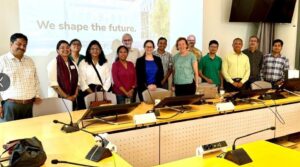
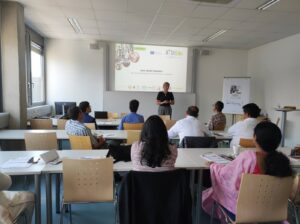
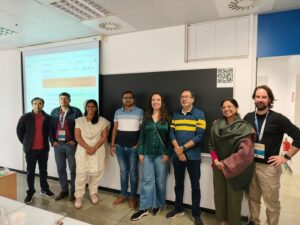
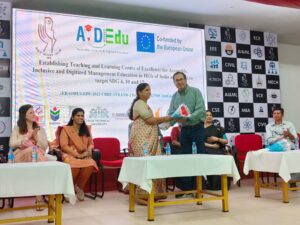
Participants valued the mix of theory and practice – in particular the World Café format in Graz and the sessions on AI-driven teaching and redesigned courses. Their main request was for more time for group discussion, which later trainings took into account.
3. Setting Up: Space and Equipment
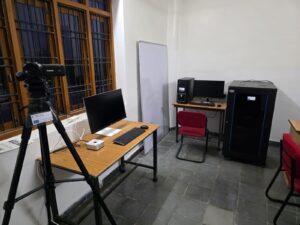
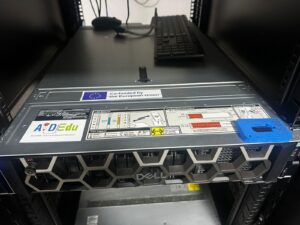
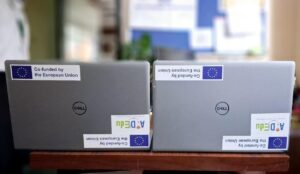
Each institution provided a dedicated room, approved by its governing body, and used its AIDEdu equipment grant to fit it out. Purchases followed each institution’s procurement rules – public tenders at BIMTECH, sealed and open quotations at Kathmandu University, comparative quotations elsewhere – and every item carries the EU “Co-funded by the European Union” label (D3.2).
Partners adapted the plan where it made sense. VESIM bought a server instead of a camera, because the server mattered more for its digital learning environment; Jaipuria replaced a planned server – already bought by the institute – with two smart boards and an extra laptop. BIMTECH designed its whole Centre around learners with disabilities.

4. Six Centres, Six Profiles
All six Centres share the same purpose, but each has its own name, focus and character.
GCI Teaching and Learning Center – Global College International, Kathmandu
Opened 6 March 2025 – the first in the network
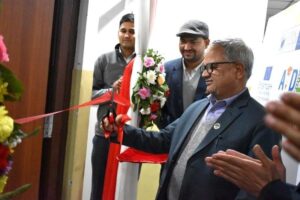
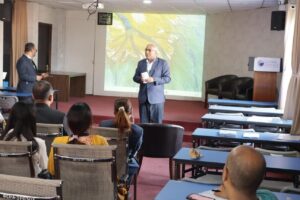
Opened by Chairman Dr Khagendra Ojha in the presence of AIDEdu coordinator Prof. Dr Shalini Bariar. Three EU-trained GCI faculty serve as the Centre’s trainers, working on digitisation, accessibility and AI in Nepalese education. GCI set out the Centre’s rules in a formal act: equal pay and non-discrimination, open dialogue, and free training for participants until the end of the project.
Centre for Teaching and Learning – Jaipuria Institute of Management, Lucknow
Opened 28 March 2025
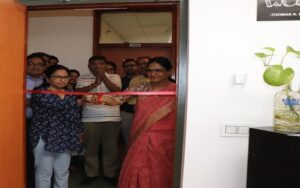
Approved by the Integral Education Society and opened by the Director, Dr Kavita Pathak. Its vision is a digitally empowered, innovation-driven ecosystem that enhances engagement, accessibility and lifelong learning for all, pursued through five goals – from accessible, inclusive teaching to continuous assessment and innovation.
Teaching and Learning Centre of Excellence – NMREC, Hyderabad
Opened 1 April 2025
Approved by the Nalla Malla Reddy Education Society and coordinated by Dr Divya Nalla, Dr Reshmi R. Nair and Dr Rajashekar A. Having hosted the February 2025 training week, NMREC opened its Centre with a focus on outcome-based education and assessment.
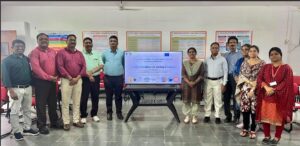
Centre of Excellence for Teaching and Learning – Kathmandu University
Launched 15 April 2025
Based in the School of Engineering at Dhulikhel and led by Mr Madhav Prasad Pandey (Director) with Dr Prabal Sapkota, Mr Yash Raj Lamsal and Dr Ram Kaji Budhathoki. CoETL was resourced jointly by AIDEdu and the University and takes a research-led approach to digital learning.
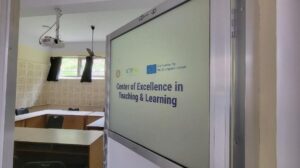
Centre of Excellence for Teaching and Learning – VESIM, Mumbai
Opened 16 April 2025
The project coordinator’s own Centre, approved by the VES Trust and the Director. It serves faculty and staff for digital literacy, accessibility training, curriculum design and technology-enhanced learning, and later hosted AHEAD 2026, the project’s international conference.
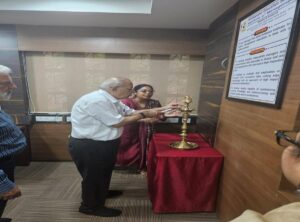

BIMTECH Centre of Education for All (BCALL) – BIMTECH, Greater Noida
Inaugurated 23 June 2025
Formally the BIMTECH Centre of Excellence for Accessible, Inclusive and Digital Learning Environment. BCALL was opened at the start of the 2025–27 batch before students, parents, industry guests and staff, and is equipped with assistive hardware and software so that learners with disabilities can use it independently.

5. First Steps: What the Centres Did First
The Centres started work almost immediately. Their first activities, reported in D3.3, show the network already working across borders – a GCI trainer in Nepal teaching VESIM faculty in India how to use Moodle.
| Centre | Activity | Date | Participants |
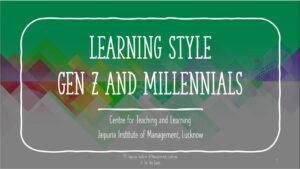
| Jaipuria | Faculty session “Learning Styles of Gen Z and Millennials” | 2 Aug 2024 | Faculty (large turnout) |
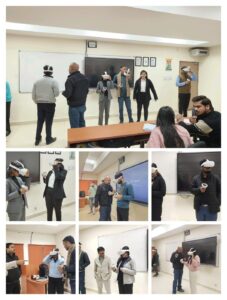
| Jaipuria | AR/VR immersive learning session, with reflective notes | 16 Dec 2024 | All PGDM students |
| Kathmandu University | Survey of student satisfaction with Moodle; report submitted to the University’s Information Systems section | Feb 2025 | School of Management students |
| NMREC | Orientation to the Centre’s objectives and plans | 1 Apr 2025 | Faculty |
| NMREC | Hands-on workshop on writing effective course outcomes | 25 Apr 2025 | 40 faculty |
| NMREC | Workshop on assessment strategies | 28 Apr 2025 | 35 faculty |
| VESIM with GCI | “Getting Started with Moodle” – online training by Mr Saroj Shrestha (GCI) | 28 Apr 2025 | All VESIM faculty |
| Kathmandu University | Presentations on AIDEdu to BBA and BBIS students | Mar & May 2025 | Students |
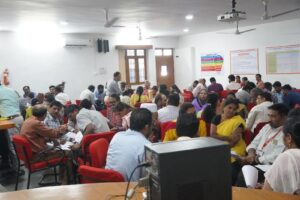
| GCI | Launch of AIDEdu faculty training (WP4) with the full training schedule | 9 May 2025 |
GCI faculty and staff
|
6. The Centres Today
Since opening, the Centres have become the engine of AIDEdu’s activity. By late 2026 the project’s event register recorded 57 activities with more than 6,700 participations at five of the host institutions – AI masterclasses, Moodle and course-design workshops, student competitions on accessibility, international webinars and the AHEAD 2026 conference.
| Centre | Selected activities, 2025–2026 |
| VESIM | International webinar on best practices in teaching and learning (97 participants); faculty Moodle trainings; host of AHEAD 2026 |
| BIMTECH – BCALL | Inkspire 2025 blog competition on accessibility (108); Train-the-Trainer Workshop for Inclusive Higher Education (25 educators) |
| Jaipuria | Six AI masterclasses for faculty; Train-the-Trainer Workshop on pedagogy (30 educators); case-learning orientations for 600+ students |
| NMREC | Workshop on AI-based assessment (80 faculty); webinar on AI in digital education (189) |
| GCI | AI Master Class (209); seminar series on AI in management (about 1,500); student digital-skills workshops |
| Kathmandu University | LMS satisfaction studies; workshops on inclusive education and autism; three chapters in the AHEAD 2026 volume |
For full profiles and photo galleries of each Centre, see the Centres of Excellence page at www.aidedu.co.in.
7. Built to Last
The Centres are designed to outlive the project:
- Institutional ownership: each Centre was approved by its governing body – the VES Trust, the Integral Education Society, the Nalla Malla Reddy Education Society, BIMTECH’s Director, GCI’s board and Kathmandu University’s School of Engineering.
- Governance: every Centre has a named head and committee, and several have advisory boards with members from all AIDEdu partners.
- Plans: Centres work to multi-year activity plans – VESIM’s runs to 2028, and Kathmandu University aims for financial independence within ten years.
- A network: the six Centres train each other, share trainers and materials, and report on common SDG indicators.
Six rooms opened in 2025. What they leave behind is a network of trained people and shared practice that will keep improving teaching and learning in India and Nepal.